This post may contain affiliate links. Please read our disclosure policy.

There is nothing more Southern than a pan of cornbread, still sizzling when it comes out of the oven, golden on the bottom from the hot cast-iron skillet. But the story of cornbread starts long before the South was even a concept. It starts with a grain, a people, and a knowledge so fundamental that it reshaped the food culture of an entire continent.
A Grain That Changed the World
Corn has been feeding people for a very long time. The crop we know today traces back roughly 9,000 years to a wild grass called teosinte, first cultivated in southern Mexico. From there, it spread across the Americas and into the hands of people who spent generations learning exactly what to do with it.
By the time European settlers arrived in North America, many indigenous peoples had built entire food traditions around corn. Across the Southeast, Native American peoples, including the Cherokee, Creek, and Seminole, were processing corn into meal, flour, and grits and making sofkee, a corn-based soup.

Cheese Grits Casserole
1 hour
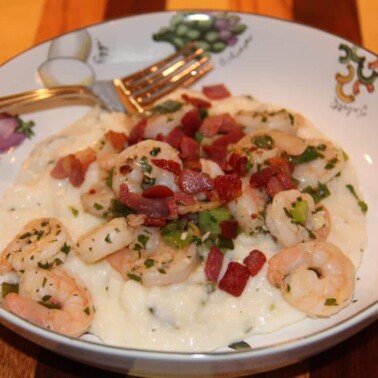
Roasted Poblano Cheese Grits
1 hour 30 minutes
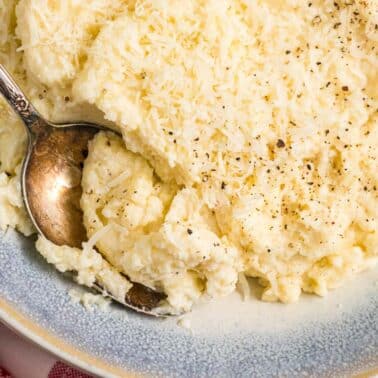
Baked Polenta with Parmesan Cheese
1 hour 10 minutes
Every part of the corn plant had a purpose, from husks woven into baskets to kernels ground into meal with a mortar and pestle. This was not a primitive pantry staple. It was a sophisticated culinary tradition developed over centuries.
The Settlers Learn a New Grain
When European settlers arrived in the South, they had every intention of growing wheat. The Southern climate had other ideas. The heat alone was enough to turn wheat rancid before it could be harvested, which quickly made wheat flour a luxury that only wealthy landowners could access.
Corn, by contrast, was sturdy, reliable, and already thriving. It became arguably the most important crop in colonial America, feeding both people and livestock while wheat and barley struggled in the American soil.
Settlers in both Plymouth and Jamestown owed their introduction to corn directly to Native Americans, who showed them how to grow it and cook with it. Those early colonial versions of cornbread were nothing like what we make today. They were unleavened and dense, closer to a Scottish oat cake than anything you’d pull from a modern oven. But they worked. And over time, colonists began using molasses, butter, and milk to fry batter into hoecakes and johnnycakes.
Three Traditions Converge
Native Americans had been working with corn for centuries. European settlers were learning from them and adapting those techniques to their own tastes. And the enslaved Africans being brought to the Southern colonies were not strangers to corn either. The Portuguese had introduced corn to West and Central Africa well before the slave trade began, so many enslaved people already knew the grain when they arrived in the Americas.
What all three groups shared was the knowledge of how to turn cornmeal into bread. Native Americans prepared corn dough by wrapping it in leaves and burying it in hot ashes to bake, a technique so fundamental that enslaved people used nearly the same method to make the breads they called hoecakes, ash-cakes, and corn pone.
The word pone itself is drawn from an Algonquian word, apan, a small piece of history hiding in plain sight on every Southern table.
Cornmeal was part of the standard ration issued to enslaved people, and they made the most of it. A cast-iron skillet, some bacon drippings, and whatever else was on hand produced a dense, crisped bread sturdy enough to hold up in thin stews and flavorful enough to become central to the Southern table.
Those recipes, developed under brutal conditions, eventually found their way into the cookbooks of the plantation houses, where landowners were served by the people who actually created the recipes.
How Cornbread Got Its Rise
The cornbread most of us grew up eating didn’t come together until the nineteenth century. Early colonial cornbread had no leavening at all, and it wasn’t until chemical leaveners became widely available that cornbread developed any real lift.
Once baking soda and buttermilk entered the picture, everything changed. The texture lightened, the flavor deepened, and the cast-iron skillet became the essential tool, with hot fat in the pan creating the crispy crust that defines the real thing.
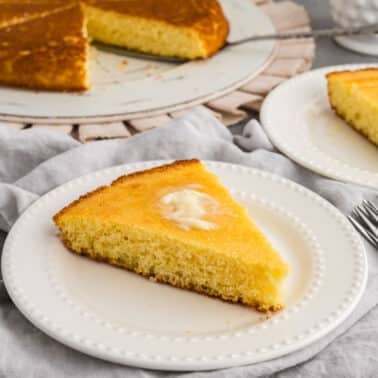
Southern Buttermilk Cornbread Recipe
35 minutes
This Southern Buttermilk Cornbread Recipe delivers golden, crispy crust and tender crumb every time, just like Grandma’s!
Traditional Southern cornbread, especially in the Deep South, is savory and unsweetened, with a crumbly texture and a crust that can only be produced by a properly heated iron skillet.
The Sugar Question
If you want to get a Southerner all riled up, just ask them if there should be sugar in the cornbread. Admittedly, even within families, there can be differences of opinion on this topic. For example, my husband loves Jiffy Cornbread because that’s what his Mama made. To me, that stuff is gritty, tasteless, dry, and about as far from real cornbread as you can get.
The regional lines are pretty clearly drawn: Northern cornbread tends to be sweetened, Southern cornbread traditionally is not, and Appalachian cornbread often skips the leaveners entirely, going back to the simplest version of the recipe.
“The North thinks it knows how to make cornbread, but this is gross superstition.”
Mark Twain
The shift toward sweetened cornbread has a specific cause. When steel roller mills replaced stone mills in the early twentieth century, the heat of the new milling process stripped out much of the corn’s natural flavor and sweetness.
Recipes were adjusted by adding sugar and wheat flour to compensate, and that version spread northward and eventually became the standard for many commercial mixes.
A Bread That Belongs to All of Us
Cornbread did not come from one place or one people. It’s the result of Native American knowledge, African ingenuity, and European adaptation, all meeting on Southern soil over several centuries, each tradition shaping the one that came next. Arguably, no American food carries more historical and cultural weight than corn.
Every pan of cornbread that comes out of a Southern kitchen carries all of that history with it. The next time you pull a hot skillet out of the oven and hear that sizzle, it’s worth a moment to think about how many hands and how many generations it took to get that recipe to your table.